My therapist thinks I should chuck the Amazon Bee Frontier out a window
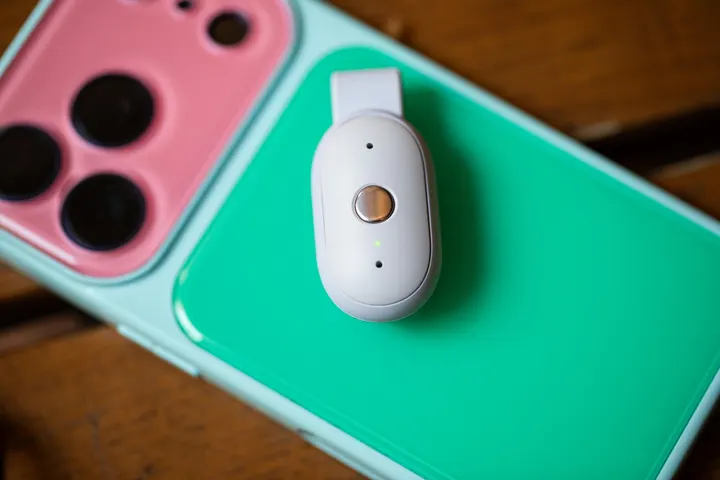
Also, can I just say this LED indicator light is way too small and unnoticeable? This is Optimizer , a weekly newsletter sent from Verge senior reviewer Victoria Song that dissects and discusses the latest gizmos and potions that swear they're going to change your life. Opt in for Optimizer here . "How does that make you feel?" I get asked this a lot in therapy. Plenty of life events, big and small, have triggered…
This is Optimizer, a weekly newsletter sent from Verge senior reviewer Victoria Song that dissects and discusses the latest gizmos and potions that swear they’re going to change your life. Opt in for Optimizer here.
My therapist thinks I should chuck the Amazon Bee Frontier out a window
Filtering conversations and memories through AI is a reality-bending lesson in why intelligence can’t replace wisdom.
My therapist thinks I should chuck the Amazon Bee Frontier out a window
Filtering conversations and memories through AI is a reality-bending lesson in why intelligence can’t replace wisdom.
“How does that make you feel?”
I get asked this a lot in therapy. Plenty of life events, big and small, have triggered this question. Three weeks ago, it was the fact that I had to ask my therapist for her consent because I was wearing the Amazon Bee Frontier during our session.
That first week, I didn’t really have an answer. A lot had changed since I first tested Bee, an always-recording AI wearable, early last year. The elevator pitch is that it listens to all your conversations and uses AI to transcribe and summarize them. From there, it has a List feature that suggests to-dos, a Grow feature for identifying areas where you can improve, and various summaries that analyze the content, tone, and takeaways from your conversations. It’s even got a chatbot that can answer questions about yourself or what was said and when.
In the last 19 months, it’s gotten better at distinguishing my actual speech from TV dialogue. It can now pull in information from my calendar and photos app, and suggest things to buy on Amazon based on what I’ve said. At times, particularly for job-related tasks, it’s helped me remember talking points. But most of the time, it’s led to me questioning my reality.
My therapist usually lets me arrive at my own decisions, even if I often take the scenic route to the obvious conclusion. After 11 years, she’s intimately acquainted with the wackier parts of my job. But in my third week of talking about Bee, my therapist requested that I chuck this thing right out a window.
It’s a bit dark, but a big reason I’m in therapy is to build trust in my own memories. I grew up with a dad who might’ve been a spy and an immigrant family that never agreed on a single version of events. Growing up, I felt unmoored. Were things truly as I’d remembered them? Were my parents the unreliable narrators, or was I? Adding in their eventual dementia to the mix made discerning truth from fiction even harder.
In those moments, I had wished for a device like Bee. A reviewable record, so to speak, for moments where I wanted a sanity check. It’s funny in retrospect. Now that tech companies have started making this fantasy into a reality, what I feel is perpetually gaslit.
For example, it’s disorienting to see Bee’s transcripts and summaries of my conversations, often because the AI remembers and interprets them differently than I do. Like any AI, it’s not always precise about who said what. In the past three weeks, it’s concluded that I argue with a coworker’s spouse frequently (I’ve never met them), that I think a family member has undiagnosed bipolar disorder (No one ever said that!), and that I like to put my good pants on for important video calls. (That was a joke.) Sure, it’s a relief that Bee’s newly updated transcription prowess was able to discern that I personally was not working with detectives Rust Cohle and Marty Hart to find a serial killer named the Yellow King simply because I watched True Detective. But it still doesn’t know how to handle the fact that we call my two cats Petey and Pablo various nicknames. By Bee’s estimation, I have about six additional cats named Mr. Handsome, Mr. Stylish, District Attorney Hoss, Dabah Doo Bah, Potato Demon, and Tubby McTubberson Jones.
These mistakes are at least funny. It’s when the conversations are serious that I feel the strongest whiplash. That’s when the “improved” AI dislodges something in my brain.
In my second therapy session with Bee recording, I spent the majority of the time unpacking my feelings about You Can See Everything. It’s a reality-bending movie that questions the line between truth and fiction. As much as I enjoyed the film, witnessing compulsive liars for three hours was bound to take me back to unhappier moments in my life. I should’ve turned Bee off for this session. But the truth is, I just forgot. Because the design of these devices is, in many ways, built for you to forget they’re listening.
One of Bee’s capabilities is that it learns “facts” about you that you then swipe right to approve as true, or left to dismiss as false. After this session, it generated a “fact” about an instance of domestic violence I experienced as a child. This particular moment has come up multiple times in sessions over the years — revisiting it has been key to understanding and forgiving my parents, holding compassion for the circumstances that shaped them.
I did not expect how awful it felt to see a traumatic event summarized so starkly in plain English. I hated having to swipe right to say, “Yes, this is true.” I didn’t expect the accompanying summary to be titled “Reclaiming Reality from Manipulative Power.” Or for it to characterize the type of person I am (deeply unsettled), the timbre of the conversation (intense, reflective, emotionally raw), or how I felt during that session (grieving, angry, and clear-eyed about manipulation). I remember that session as cathartic. There were times when I laughed or joked around. The topic was serious, yes, but I wasn’t ranting, raving, or crying. I left that session feeling light — you’d never guess that from the summary. Looking at it weeks later, I’m now wondering who’s right: me, or the AI.
I also forgot to turn Bee off during my annual physical. I was late to the appointment, and when I changed into a gown for the exam, the damn thing was just sitting in a pile of my clothes. I only realized my mistake when it was time to leave.
On the one hand, it did memorialize that my doctor prescribed me Claritin for allergies and that the nurse and I talked about my dead dog Daisy. (It described me as wistful and grieving here, too, but I recall it as fond remembrance.) Ironically, it also memorialized my doctor’s feelings on AI transcription. My doctor’s AI transcription software requires patient consent and helps her with long conversations where she has to remember treatment notes. But it’s also garbage at distinguishing between two female speakers, and she spends a decent amount of time correcting it.
Depending on which Bee AI template I use, it can change the summary. With the default template, the AI’s conclusions about this particular meeting include tonal analysis and takeaways. If I filter to the medical visit template, suddenly everything is much more factual. It strips away the ruminations. It’s more useful and less uncomfortable to look back on. But I also can’t help but feel that the record of what was a fairly significant healthcare appointment differs from my memory. Who is right?
So, how does this all make me feel?
A little bit crazy and overwhelmed. Sometimes offended. Bee has a new-ish feature called Grow. Based on your conversation history, it compiles recommendations on how you can grow as a person. It also generates suggested to-dos.
To train Bee AI on my voice, during setup it asked me to describe my hobbies. I said I enjoy reading, calligraphy, cross-stitch, and running. I’ve recently gotten into fountain pens and ink swatching for journaling. You have to talk for about two minutes straight, so I ended up rambling about how I was unsure whether embroidery would be a natural progression from cross-stitch or an unnecessary side quest at this point in time.
The Grow insight based on this incredibly unserious, one-sided discussion? A conversation Bee itself prompted. I dabble in too many hobbies without serious commitment. A jack of all trades, master of none. I’ve shown no progression or tangible sign of “shareable output” and should spend the next three months picking one hobby. Because I allowed Bee to integrate with my reminders list, which has an old to-read list for books I want physical copies of, it confidently stated that despite calling myself a reader, I haven’t made much progress this year.
Bitch, I thought, I’ve finished 39 books in 2026 so far. I’ve been practicing calligraphy and journaling for 17 years. I finished 10 cross-stitch projects this year. Most importantly, hobbies aren’t something I do for “shareable output.” I happen to firmly believe that hobbies should be exempt from cockamamie Silicon Valley-brained KPIs.
Another Grow insight from some political discussion with my spouse about the midterms? “These frameworks help her contextualize current events but may also distance her from present-tense engagement; her tone in political discussion is more analytical than activist, more diagnostic than mobilized.” It then suggested that I “identify one concrete political action aligned with your values that requires less than 30 minutes and complete it this week.”
In my memory, this was because we watched an episode of The Daily Show and I said, jokingly, that I was tired of US political shenanigans. Never mind my actual lived experience canvassing and as a union organizer and representative.
These are just two examples. Imagine seeing some version of this every day for nearly a month. Summaries that are maybe 75 percent right, 15 percent taken out of context, and 10 percent out-of-pocket wrong. Things that are just presented to you as fact, regardless of whatever disclaimer that AI can make mistakes.
You can know the truth deep in your gut and still wonder what happens when your hypervigilance slips.
I said as much in my third therapy session wearing Bee. I asked my therapist to weigh in. What, I joked, did she feel watching me go through this experiment?
I’ve gone through the Bee transcript of that conversation. Ironically, it didn’t summarize her thoughts on how poorly designed this device is for anxious people. I had to dig into the raw transcript to find that. According to my therapist, a device like this likely supersedes a person’s ability to trust their own instincts about what they need to do. When you outsource that, AI can generate insights that aren’t emotionally attuned and, in turn, exacerbate many of the problems a person might be trying to solve. For me, it likely triggers rumination, spiraling, and perfectionism.
That’s the point where we joked that I should probably throw this thing out the window. We laughed that we’d both feel relieved when I’m not wearing this at my next session. I would say that was the most important takeaway.
Bee didn’t include that in my suggested to-do list. It did, however, say this: buy nail glue, complete with a link out to Amazon.