TeamGroup GA Pro 2TB SSD Review: A faltering attempt at a mid-range PCIe 5.0 SSD
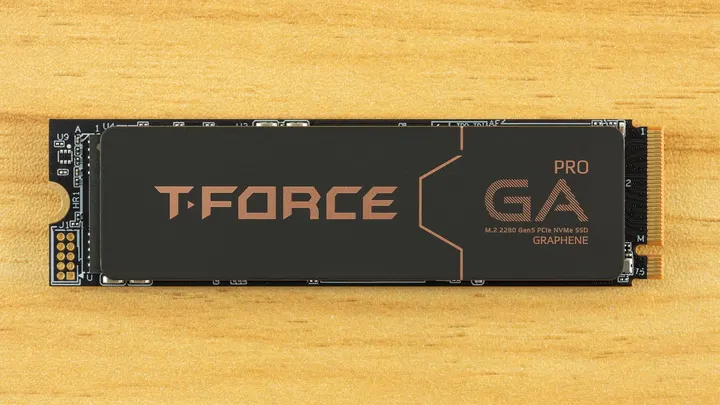
Every once in a while we get a drive that comes across our desk that stands out, for good or for bad. The TeamGroup GA Pro falls into the latter category, enough so that we re-checked our results and contacted the company. We’ve managed to mostly sort out what’s going on and, while this is not the worst drive around, it has enough problems that we would generally not recommend it except if it's on steep sale…
Every once in a while we get a drive that comes across our desk that stands out, for good or for bad. The TeamGroup GA Pro falls into the latter category, enough so that we re-checked our results and contacted the company. We’ve managed to mostly sort out what’s going on and, while this is not the worst drive around, it has enough problems that we would generally not recommend it except if it's on steep sale. TeamGroup’s array of storage offerings knows no bounds: if there’s a niche to cover, it makes an attempt. The GA Pro feels like such a try, although we’re not completely sure where it fits into the mix. The company is still working to iron out the bugs, if it can, but the technology is old enough that we wouldn’t hold our breath. On paper, it’s a PCIe 5.0 drive with DRAM that should beat any PCIe 4.0 SSD, but we found it struggles to live up to its own class of drive. Bright points are few and far between, but at least we can say it’s not the worst drive we’ve seen. The edges are just rougher than usual. TeamGroup GA Pro Specifications Product 1TB 2TB 4TB 8TB Pricing N/A $331.99 N/A N/A Form Factor M.2 2280 (graphene heatsink) M.2 2280 (graphene heatsink) M.2 2280 (graphene heatsink) M.2 2280 (AirFlow I heatsink) Interface / Protocol PCIe 5.0 x4 / NVMe 2.0 PCIe 5.0 x4 / NVMe 2.0 PCIe 5.0 x4 / NVMe 2.0 PCIe 5.0 x4 / NVMe 2.0 Controller InnoGrit IG5666 InnoGrit IG5666 InnoGrit IG5666 InnoGrit IG5666 DRAM Yes 2GB DDR4 Yes Yes Memory YMTC 232-layer TLC YMTC 232-layer TLC YMTC 232-layer TLC YMTC 232-layer TLC Sequential Read 10,000 MB/s 10,000 MB/s 10,000 MB/s 10,000 MB/s Sequential Write 8,500 MB/s 8,500 MB/s 8,500 MB/s 8,500 MB/s Random Read N/A N/A N/A N/A Random Write N/A N/A N/A N/A Security N/A N/A N/A N/A Endurance (TBW) 600TB 1,200TB 2,400TB 4,800TB Part Number TM8FFJ001T0C129 TM8FFJ002T0C129 TM8FFJ004T0C129 TM8FGL008TTC133 Height 3.9 mm (w/ graphene) 3.9 mm (w/ graphene) 3.9 mm (w/ graphene) 62.3 mm (w/ AirFlow I) Warranty 5-Year 5-Year 5-Year 5-Year The TeamGroup GA Pro is available in 1TB, 2TB, 4TB, and 8TB capacities, although we only have the 2TB showing up at $331.99 at retail right now. The 8TB will probably be hard to find at this point. The drive is rated for up to 10,000 / 8,500 MB/s for sequential reads and writes, with no IOPS rating, although a drive like this can achieve 1 million or more. It has the standard five-year warranty with up to 600 TB of writes per TB of capacity. TeamGroup GA Pro Software and Accessories TeamGroup has a number of downloads available for this range of drives, which is better than nothing. They do maintain firmware for their drives, and we made sure our test sample had the newest revision, 050g05E7. Also available is the SSD S.M.A.R.T. TOOL, which is their SSD toolbox with basic functions, such as health monitoring. For backup and cloning on Windows, we continue to recommend MultiDrive, which continues to be updated based on user feedback. TeamGroup GA Pro: A Closer Look Tom's Hardware Tom's Hardware Tom's Hardware The good news is, the GA Pro has a graphene heat-spreading label. The bad news is, it’s insufficient to cool this drive. In most cases, you will want a heatsink on this. You can use a heatsink with the label in place, but you will have better luck if it’s removed. We are fond of graphene labels as they can be surprisingly effective, but it’s just not enough here. Then we have the label which, with the 3.3V / 2.5A rating, puts the drive at a very optimistic 8.25W. We measured over 12.5W peak in our testing below. We can’t go by reported power states, as these top off at 3.50 W. Since we can’t rely on that, we can’t say for sure what even the expected enter/exit latencies are, relevant given TeamGroup’s claims about the drive, which we’ll get to later. The drive is otherwise double-sided with a controller, two DRAM packages, and four NAND flash packages. Tom's Hardware Tom's Hardware Tom's Hardware The SSD controller is InnoGrit’s IG5666, the company’s answer to the Phison E26 high-end PCIe 5.0 champion. We have better controllers in that segment now, like the E28 and SMI’s SM2508, but even at the time of release, the IG5666 was not very popular. Both the E26 and IG5666 run very hot due to using an older process node, and newer flash wasn’t available yet to more easily reach the bus speeds needed. The GA Pro is not running full-out but, to be honest, that doesn’t help much. Phison put a lot of work into getting the E26 up to full speed in steps, and even the base 10 GB/s ones run toasty. The drive does have the right amount of DDR4, 2GB, for this amount of flash. No problems there. The flash also looks to be YMTC’s 232-layer TLC, which is also perfectly fine. The controller is the weak spot here and, as we’ll find out, its firmware really keeps the GA Pro from reaching its full potential, even with its bandwidth cap. MORE: Best SSDs MORE: Best External SSDs MORE: Best SSD for the Steam Deck Comparison Products We’re throwing a mix of drives today at the GA Pro, in the interest of finding out why it performs the way it does. Direct competitors include the Crucial T700 and Corsair MP700 , two Phison E26-based drives. The MP700 is rated at around the same speeds as the GA Pro, while the T700 is a step up, about halfway from there to the E26’s 14 GB/s effective ceiling. We also have the TeamGroup GE Pro sibling as a drive with similar hardware to the GA Pro but rated for the InnoGrit IG5666 controller’s full speed. The Addlink G55 , PNY CS2150 , and Crucial P510 also hover around the same specs but are later-arriving, DRAM-less drives. We also have the Lexar NM1090 Pro (4TB) in the mix as it’s a high-end PCIe 5.0 drive, but considered slightly more budget-leaning. Finally, the TeamGroup G70 Pro is our PCIe 4.0 stand-in for a last-gen comparison, from the same company and also with an InnoGrit controller. Trace Testing — 3DMark Storage Benchmark Built for gamers, 3DMark’s Storage Benchmark focuses on real-world gaming performance. Each round in this benchmark stresses storage based on gaming activities including loading games, saving progress, installing game files, and recording gameplay video streams. Future gaming benchmarks will be DirectStorage-inclusive and an evaluation for future-proofing is included where applicable. Tom's Hardware Tom's Hardware Tom's Hardware There’s no doubt about it; the GA Pro’s response here is quite poor. The drive’s score of 1,428 puts it pretty close to the SATA SSD range of around 1,000 to 1,400, and second to last of the 242 NVMe drives in our database. Now, this is plenty fast for gaming and much better than using an HDD, but it’s also terrible for an NVMe SSD, and we would not recommend it for this. Right out of the gate, we began to question this drive’s results. We switched up our comparison drives, re-ran the tests, and ultimately contacted TeamGroup. In theory, this score is what we would expect given their explanation, which was that the drive was designed for CDM, ATTO, and sustained writes to get the most out of its bandwidth potential. The firmware being used drops the drive into a lower power state when the host is idle, and this can add unwanted command latency. That matches the 3DMark latency result. Optimizing for certain workloads makes sense, but we don’t think this result is defensible. The likeliest reason for any such design, beyond the stated one, would be to handle heat. This controller runs hotter than any other PCIe 5.0 one we’ve tested. So, this is almost OEM-drive-like behavior, in the sense that it’s really trying to keep the drive within a certain envelope. We think the firmware is not operating as intended, but we at least accept the theory. Trace Testing — PCMark 10 Storage Benchmark PCMark 10 is an industry standard trace-based benchmark that uses a wide-ranging set of real-world traces from popular applications and everyday tasks to measure the performance of storage devices. The results are particularly useful when analyzing drives for their use as primary/boot storage devices and in work environments. Tom's Hardware Tom's Hardware Tom's Hardware We see the same issue in PCMark. Terrible latency leads to terrible overall results. The drive may not be slow intrinsically, but it might as well be considered as such. Our hypothesis here, since the problem is consistent, is that the drive is unintentionally throttling. Usually this happens due to heat, but saying “heat” is not fully addressing the problem. That is, it’s not necessarily the heat causing the issue but how the drive and firmware detect and handle it. We remember the days of prototype PCIe 5.0 controllers, mainly from Phison, where flash temperatures were not properly calibrated and caused unintentional throttling. It’s possible something similar is happening here, given how hot the controller runs (see our power and temperature section), but the early takeaway for now is that this is a “solved” problem that InnoGrit is struggling with on this drive for one reason or another. Console Testing — PlayStation 5 Transfers The PlayStation 5 is capable of taking one additional PCIe 4.0 or faster SSD for extra game storage. While any 4.0 drive will technically work, Sony recommends drives that can deliver at least 5,500 MB/s of sequential read bandwidth for optimal performance. Based on our extensive testing, PCIe 5.0 SSDs don’t bring much to the table and generally shouldn’t be used in the PS5, especially as they may require additional cooling. Check our Best PS5 SSDs article for more information. Our testing utilizes the PS5’s internal storage test and manual read/write tests with over 192GB of data both from and to the internal storage. Throttling is prevented where possible to see how each drive operates under ideal conditions. While game load times should not deviate much from drive to drive, our results can indicate which drives may be more responsive in long-term use. Tom's Hardware Tom's Hardware Tom's Hardware We usually don’t worry about the PS5 with PCIe 5.0 drives, as even the slowest ones are plenty for the console, but we wanted to be sure with this one. The drive works but does not perform that well. Given how brief this testing can be, and because it’s limited to PCIe 4.0 speeds, we don’t believe the drive is throttling. It’s more likely the same latency issue we saw in the trace tests, or a larger firmware issue. Transfer Rates — DiskBench We use the DiskBench storage benchmarking tool to test file transfer performance with a custom 50GB dataset. We write 31,227 files of various types, such as pictures, PDFs, and videos to the test drive, then make a copy of that data to a new folder, and follow up with a reading test of a newly written 6.5GB zip file. This is a real-world type workload that fits into the cache of most drives. Tom's Hardware Tom's Hardware Tom's Hardware The GA Pro also ends up dead last in DiskBench, which also requires explanation. The drive has a very small cache for its size and generation, something that is also OEM- or NAS-like rather than what we’d expect from a normal retail drive, but it’s large enough to fit this test. Either the cache was not fully emptied in testing, which generally would also be linked to firmware, or we’re having more issues here from the previously mentioned flaw. The drive is also slower with reads because the reads in this test are at a queue depth of 1, where the drive is known to have issues; this was affirmed by TeamGroup when we asked. Synthetic Testing — ATTO / CrystalDiskMark ATTO and CrystalDiskMark (CDM) are free and easy-to-use storage benchmarking tools that SSD vendors commonly use to assign performance specifications to their products. Both of these tools give us insight into how each device handles different file sizes and at different queue depths for both sequential and random workloads. Tom's Hardware Tom's Hardware Tom's Hardware Tom's Hardware Tom's Hardware Tom's Hardware Tom's Hardware Tom's Hardware Tom's Hardware Tom's Hardware Tom's Hardware Tom's Hardware Tom's Hardware Tom's Hardware The GA Pro isn’t actually all bad here, with reasonable ATTO curves and even some okay marks in CDM. 4KB latency is still higher than expected, and that hurts this drive for everyday use. On the other hand, it can mete out some decent sequential performance, especially at QD8. TeamGroup told us that this is what the drive was designed for, so that lines up. Keep in mind, this drive isn’t going to keep up with PCIe 5.0 drives rated for higher speeds. Instead, to keep it on the positive side, at QD8 it does very well against drives with similar specs. Sustained Write Performance and Cache Recovery Official write specifications are only part of the performance picture. Most SSDs implement a write cache, which is a fast area of pseudo-SLC (single-bit) programmed flash that absorbs incoming data. Sustained write speeds can suffer tremendously once the workload spills outside of the cache and into the "native" TLC (three-bit) or QLC (four-bit) flash. Performance can suffer even more if the drive is forced to fold, the process of migrating data out of the cache in order to free up space for further incoming data. We use Iometer to hammer the SSD with sequential writes for 15 minutes to measure both the size of the write cache and performance after the cache is saturated. We also monitor cache recovery via multiple idle rounds. This process shows the performance of the drive in various states including the steady state write performance. Tom's Hardware Tom's Hardware Tom's Hardware The GA Pro’s fastest mode, pSLC, or what’s called the cache, writes at around 9.2 GB/s. This is respectable for the drive’s speed class and beats any PCIe 4.0 drive, but also doesn’t set records. It only writes at this speed for approximately 7 seconds, which is incredibly short, and means the cache is only about 69 GB in size. This is small in general, small for a 2TB drive, and very small for a modern, PCIe 5.0 drive. It’s not unheard of, as we’ve seen caches around this size on some drives to improve “quality of service,” which basically means keeping the drive performing consistently even when the cache runs out. We don’t see that, per se, after the cache runs out here. The drive initially acts in an erratic manner, although eventually it does hit a steady speed around 2.5 GB/s. This isn’t too bad, but the drive should be able to muster a little bit more: the G70 Pro, with the same YMTC flash and an even smaller cache, manages about 2.75 GB/s. Still, it’s fast enough to be useful for some applications. TeamGroup suggested this is one area the drive was designed to be good at, and while we can’t agree with that 100%, we do think its current arrangement is, on paper, good for something like write caching. It would be better if things were smoothed out, maybe through firmware, and we would absolutely recommend a good heatsink for that type of workload on this drive. Power Consumption and Temperature We use the Quarch HD Programmable Power Module to gain a deeper understanding of power characteristics. Idle power consumption is an important aspect to consider, especially if you're looking for a laptop upgrade, as even the best ultrabooks can have mediocre stock storage in terms of capacity and performance. Desktops are often more performance-oriented with less support for power-saving features, so we show the worst-case for idle. Some SSDs can consume watts of power at idle while better-suited ones sip just milliwatts. Average workload power consumption and max consumption are two other aspects of power consumption, but performance-per-watt, or efficiency, is more important. A drive might consume more power during any given workload, but accomplishing a task faster allows the drive to drop into an idle state more quickly, ultimately saving energy. For temperature recording, we currently poll the drive’s primary composite sensor during testing with a ~22°C ambient. Our testing is rigorous enough to heat the drive to a realistic ceiling temperature, but real-world temperatures will vary due to the environment and workload factors. Tom's Hardware Tom's Hardware Tom's Hardware Tom's Hardware At this point in the review, you’re probably thinking to yourself: I bet the GA Pro isn’t very power-efficient, either. You’d be correct; it finishes last in our lineup. That comes down to its slow DiskBench copy speed, which our efficiency metric is based on, paired with high power draw: the GA Pro averages 6.32W, fourth-highest in our lineup, and peaks at 12.53W, the highest. Also, its hardware is already known to be inefficient even compared to comparables like a Phison E26 and Micron TLC on the MP700; see the GE Pro. We also don’t really expect great power efficiency out of a drive like this. That said, yeah, don’t get this drive if you care about that. One thing we’ll add is that TeamGroup’s claim about latency fits the results here: the GA Pro’s idle power consumption is significantly better than the GE Pro’s. Temperature-wise, well, what can we say? The three sensors reported maximum temperatures of 61, 72, and 92 degrees Celsius. The 92-degree reading is most likely the controller, which held at 88 degrees or higher for over 90% of our sustained write test. The drive’s 90-degree warning threshold applies to the composite sensor, which peaked at 72 degrees, and it stayed below that threshold. But the controller holding steady at around 89 degrees in some cases suggests the firmware may be working around that temperature instead. Either way, yes, this drive runs hot. Mind, this is with cooling, so you would definitely want to be prepared to handle this one. Test Bench and Testing Notes CPU Intel Core i9-12900K Motherboard Asus ROG Maximus Z790 Hero Memory 2x16GB G.Skill DDR5-5600 CL28 Graphics Intel Iris Xe UHD Graphics 770 CPU Cooling Enermax Aquafusion 240 Case Cooler Master TD500 Mesh V2 Power Supply Cooler Master V850 i Gold OS Storage Sabrent Rocket 4 Plus-G 2TB Operating System Windows 11 Pro We use an Alder Lake platform with most background applications such as indexing, Windows updates, and antivirus disabled in the OS to reduce run-to-run variability. Each SSD is prefilled to 50% capacity and tested as a secondary device. Unless noted, we use active cooling for all SSDs. TeamGroup GA Pro Bottom Line We test many, many drives and only rarely, exceptionally, do we consider giving out a perfect score. That’s because the perfect drive is essentially a unicorn. The same goes the other way, too: to get our very worst rating, a drive would have to be truly awful. Now, the TeamGroup GA Pro is among the worst drives I’ve handled in my tenure, but I’ve heard of many worse. Drives that fail at the drop of a hat, ones plagued with firmware issues, ones with low-grade flash, ones with PCIe 3.0 or worse performance. They exist, and the GA Pro is not one of these. We also reviewed tons of drives from TeamGroup; this is a known brand that also communicated to us the need for a firmware revision, which makes us feel like the InnoGrit controller choice is the biggest issue here. (Image credit: Tom's Hardware) The GA Pro is an odd drive, anyway, because it’s not fast for a PCIe 5.0 drive. It’s at first-gen speeds for the high-end drives in this class, with the next two steps being 12 and 14 GB/s or so, and it ends up competing with later-arriving 10 GB/s drives that are DRAM-less and far more efficient. If you’re looking at a chart of drive generations like it was showing an evolution, this drive is halfway to being a dinosaur at this point. If we look at the problems Phison had early with the E26, we can see some misstep overlaps here. Our feeling is that TeamGroup had a rough idea of what they wanted this drive to be, and there are many hints at that, like the small cache size, and the vision never panned out. Not surprising given the controller has never done well and the consumer SSD industry at this point is exceptionally bad. No excuses here, though. Performance is very bad for this class in many areas, especially with low QD reads, presumably due to a latency issue, which hits the drive hard. Power efficiency is also pretty bad, not unexpected, though, and the drive runs hot. That’s also expected from this hardware. On the other hand, sustained write performance is not terrible once it steadies out, and in some high-QD situations the drive even outperforms its spec. We think TeamGroup could have slotted this into a NAS-like category or even HEDT like other early PCIe 5.0 SSDs. The cache speaks to that, although we’ve seen some Phison-based drives use a smaller cache to smooth out write performance. Which means that TeamGroup may have been targeting a similar milieu, but of course putting the GA Pro up against an E31T drive, like the P510, makes little sense to us. We cannot recommend the drive in its current form; it needs a firmware update. With that update, and if pricing is respectable, the drive has some niche applications. It could tank some higher QD sequential workloads and let you induce less wear on your better or more important drives. Certainly, most drives in this class have massive caches, and that’s not always a good thing. The problem is we would still probably go with those over a GA Pro even where they may be slower. This drive feels more like one you find $100 off on a sale that seems like a misprice some random Sunday, in which case, well, you could do worse. MORE: Best SSDs MORE: Best External SSDs MORE: Best SSD for the Steam Deck