I loved the vivo X500 Pro Max, but one thing is holding it back from greatness
It’s Pro Max season, and like its fellow Chinese brethren, vivo couldn’t resist using iPhone-esque naming with the X500 Pro Max. If anything, the X500 Pro Max does a better job living up to its name, thanks to a bigger 6.85-inch panel, a 7,800mAh battery (6,750mAh in the EU), and all the extras you’d associate with a high-end Android phone in 2026. Other than that, though, you’re not going to see a huge difference…
Affiliate links on Android Authority may earn us a commission. Learn more.
I loved the vivo X500 Pro Max, but one thing is holding it back from greatness
Nov 4, 2026 — 6:00 AM ET
vivo X500 Pro Max
MSRP: $1,599.00
What we like
What we don't like
vivo X500 Pro Max
It’s Pro Max season, and like its fellow Chinese brethren, vivo couldn’t resist using iPhone-esque naming with the X500 Pro Max. If anything, the X500 Pro Max does a better job living up to its name, thanks to a bigger 6.85-inch panel, a 7,800mAh battery (6,750mAh in the EU), and all the extras you’d associate with a high-end Android phone in 2026.
Other than that, though, you’re not going to see a huge difference from 2025’s X300 Pro (which this phone is the successor to, despite there also being an X500 Pro — I’ll explain this in the verdict I promise). While OPPO went with three 200MP cameras to make the Find X10 Pro Max stand out, vivo chose a more conservative path, focusing on iterative camera upgrades and tweaks to the tuning.
Just like the Find X10 Pro Max, the X500 Pro Max is now available globally (albeit in select markets, and not in the US). You’ll need to shell out €1,599 (~$1,780) for the 12GB/256GB model, €1,799 (~$2,000) to get the 12GB/512GB edition, and €2,199 (~$2,450) for the 12GB/1TB variant. To put that into context, last year’s 16GB/512GB X300 Pro debuted at €1,399 (~$1,560), so you’re paying a lot more for a phone that isn’t drastically different.
Annoyingly, price hikes are the case with just about every consumer tech product in 2026, and the ongoing “RAMageddon” combined with flagging sales means brands have resorted to raising prices across the board. The Find X10 Pro Max costs the same as the X500 Pro Max, and with Xiaomi set to bring the Xiaomi 18 Pro Max to global markets very soon, it’s a safe bet to assume it will be priced at a similar level. Anyway, let’s talk about what the X500 Pro Max is like to use, and whether you should consider buying one if it’s on sale in your region.
These cameras are incredible
Cameras continue to dominate the conversation around vivo’s phones, and the X500 Pro Max has a lot to offer in this area. vivo didn’t change the camera resolution, but instead outfitted the phone with new sensors; you get a 50MP Sony LYTIA L910 main camera with a 1/1.28-inch sensor, 24mm focal length, and gimbal optical image stabilization (OIS).
The main camera is joined by a 200MP Samsung ISOCELL HP0 1/1.4-inch tele lens with 85mm focal length and OIS, and the ultrawide lens gets a much-needed upgrade to the Samsung ISOCELL JN5, bringing autofocus, 15mm focal length, and a 1/2.75-inch module. Having used the X300 Ultra and its 35mm default focal length, I found it interesting to switch to the X500 Pro Max’s 24mm; while 35mm makes sense for video, I prefer using 24mm as I mostly take photos.
Regardless, video is still a key area of focus for vivo, and the X500 Pro Max gets subject tracking, with the ability to stay locked on a moving subject even in a crowd. There’s also 4K cinematic portrait video, 4K 240fps HDR video, which the Find X10 Pro Max doesn’t offer despite using the same Dimensity 9600 Pro, and 4K at 120fps Log video if you need greater control.
There’s no shortage of shooting modes and filters, and you can easily customize the look and feel of your images. The best part is that you get the ability to alter the tonality of the photos after the fact, and I like that both OPPO and vivo borrowed this feature from Apple.
The 200MP tele lens is the star of the show.
vivo retained the 200mm and 400mm telephoto extender lenses this time, and the X500 Pro Max is available with an optional camera kit that bundles both lenses. These are the same Gen 2 lenses that debuted with the X300 series, and I think vivo did a better job in this area than the optional Hasselblad Teleconverter kit for the Find X10 Pro Max. While it adds to the price of the phone, I think it is a worthwhile investment if you’re considering the X500 Pro Max; the lenses bring much greater versatility, and the 200mm in particular is fantastic at shooting portraits.
While it doesn’t have a trio of 200MP cameras, the X500 Pro Max holds its own against the Find X10 Pro Max. Image quality is consistent across all lenses, and the cameras do a brilliant job even in low-light situations. You don’t get the same true-to-life color rendition as the Find X10 Pro Max, but the ZEISS-tuned Natural mode isn’t that far off either. I predominantly used the Vivid mode as it delivered shots with better vibrancy without making the resultant images look overly saturated like images from Samsung devices.
The 200MP tele lens is the star of the show, and it reliably delivers great photos at 3.5x and 7x zoom. It doubles as a portrait shooter, and I think vivo’s phones take better portrait imagery than any other brand’s. Overall, I prefer vivo’s color rendition and tuning, and in that context, I like the X500 Pro Max better than the Find X10 Pro Max, but there’s no arguing that these two are among the best camera flagships of the year.
The design hasn’t changed much
The X500 Pro Max feels similar to hold and use to its predecessor, but the taller design and bigger battery make it a little heavier at 229g. The weight is evenly distributed, so it doesn’t feel unwieldy even though it has a massive camera, and the beveled sides and rounded edges make it comfortable to hold.
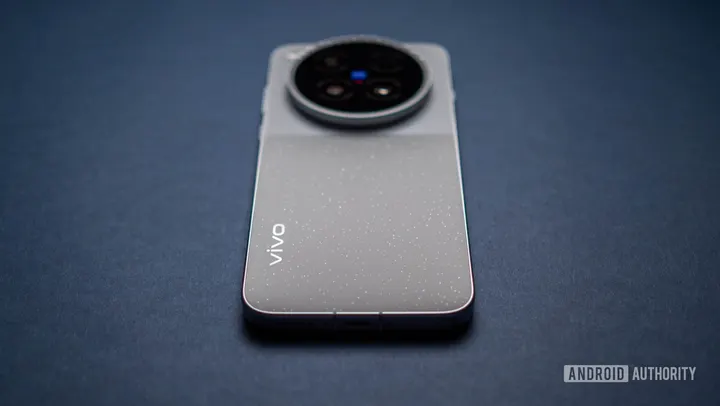
The camera island dominates the design at the back, and there’s a metal ring encircling the module. The positioning means that there’s no wobble when using the X500 Pro Max on a desk, and I like that about vivo’s devices in general. I’m using the Starry Gray model of the phone, and it has a two-tone design with a shimmer pattern that looks much better than the images otherwise suggest. The other options are Moonlit Black, Sunny White, and Sunset Orange — there’s no denying that the latter is the one to get if you need a phone that immediately grabs attention.
I didn’t see any issues with build quality or durability in the two weeks I used the X500 Pro Max. The phone gets an aluminum mid-frame and has the standard IP68 along with IP69K dust and water resistance, and it can take a beating. It took a few tumbles and came away unscathed, but I’d still recommend using it with a case — there’s one bundled in the box.
The shortcut button returns this year, on the left side. It’s similar to the Action button on the iPhone 18 Pro Max, and the feature set is nearly identical as well — down to the design of the system menu. The button has press-and-hold and double-press actions and is highly customizable, and you can use it to take notes, toggle the flashlight, switch ring modes, and so much more.
Raising the bar for flagships
The X500 Pro Max has a 6.85-inch panel with a resolution of 3,168 x 1,440, marking the return of QHD panels on the Pro tier. The panel is a smidgen larger than the X300 Ultra’s, and it has vibrant colors with a 120Hz low-temperature polycrystalline oxide (LTPO) panel (going up to 144Hz in select games), and all the customizability you need. Gaming is highly enjoyable on the screen, and the phone holds up just as well with Dolby Vision content. It gets 2,000 nits of brightness across the entire screen and is one of the brightest devices I’ve tested. It hits a maximum of 4,400 nits across 20% of the screen in outdoor use, and again, that puts it squarely in contention with the Pixel 11 Pro XL as one of the brightest phones around.
Where it wins out over the Pixel is 2,160Hz ultra-high-frequency dimming, making it much easier on the eyes. It goes down to one nit at night, has a hardware-level blue light filter and anti-fatigue brightness adjustment, and switches to warmer hues at night. Basically, you get a lot of eye-comfort features that Google and Samsung just don’t offer at the moment, including anti-fatigue modes, circularly polarized light, and full-screen bionic brightness. The idea behind these modes is to reduce eye-strain and fatigue. While Google and Samsung have their own take on eye comfort, I found that Chinese brands go above and beyond in this area.
MediaTek rolled out the 2nm Dimensity 9600 Pro last month, and the X500 Pro Max uses it to good effect. Other than the camera-focused changes made possible because of the new silicon, it brings generational gains in just about every area, but the biggest difference I noticed is in battery life. The switch to 2nm brings much better efficiency, and the X500 Pro Max dominates just about every other phone in this regard.
Nothing illustrates the memory crisis better than the X500 Pro Max’s storage configurations: It is available with 256GB, 512GB, and 1TB of storage, and all variants come with 12GB of RAM as standard. Annoyingly, even my 1TB model gets 12GB of RAM, and that’s a clear downgrade considering its predecessors had 16GB. vivo sells 512GB and 1TB variants in China with 16GB memory, but the global models are limited to 12GB.
There were no issues with cellular or Wi-Fi connectivity in my testing, and the X500 Pro Max doesn’t really miss out on anything in this regard. There’s Wi-Fi 7, Bluetooth 6.0, aptX HD, LHDC, NFC, dual-band GPS, and a USB-C port with USB 3.2 speeds and USB On-The-Go (OTG) support, allowing you to connect the phone to XR glasses or a monitor with relative ease.
The ultrasonic fingerprint sensor is one of the best you’ll find on any phone, and it works even with wet fingers — ideal if you’re using the X500 Pro Max at the pool. The sensor itself is well positioned on the screen, and it’s easy to unlock when holding it one-handed. On that note, the haptic motor has good feedback, and you can customize the intensity of the motor and select when you want to trigger it.
This phone is a battery powerhouse
Battery anxiety just isn’t a thing with Chinese phones in general, and the X500 Pro Max comes with a 6,750mAh silicon-carbon battery on the EU model. This is a decent enough differentiator, as the global X300 Pro had a much smaller 5,440mAh battery last year. Now, the global model is much better as it has a bigger 7,800mAh battery, and this is the variant I used. I consistently got a day and a half even with heavy use, averaging two days between charges most of the time.
When it comes to charging, the phone has 90W charging based on vivo’s FlashCharge protocol, but since you don’t get a charger bundled in the box, you’ll need to buy a power brick to unlock the full charging potential. What I do instead is use standard USB Power Delivery (PD) chargers with the X500 Pro Max; the phone charges at 50W via PD, and honestly, the convenience is worth the slower charging.
If anything, the 50W standard doesn’t vary that much from vivo’s own 90W; the X500 Pro Max took just under 80 minutes to charge with a vivo charger, and it’s clear that the brand is using a conservative charging profile to prevent battery degradation. This is the case with all Chinese manufacturers using a higher amount of silicon-carbon mixture in the anode, and honestly, I’m fully on board with this idea — even with slower charging, you’re not waiting around too long, and the advantage is that the battery longevity isn’t affected to any measurable degree. There’s 40W wireless charging as well, but again, you’ll have to buy vivo’s custom charger to get the full 40W.
You won’t find built-in Qi2 magnets either, so you’ll have to buy aftermarket cases to enable the feature. The only issue with that is that most mainstream case brands don’t make cases for the X500 Pro Max, and vivo doesn’t make first-party magnetic cases. Clearly, vivo needs to take a page from OPPO’s playbook and start offering magnetic cases and other accessories — like the OPPO Bubble — for its flagships.
There’s a lot to like in OriginOS 7
vivo did all the right things with the software on the X500 Pro Max; the phone runs Android 17 out of the box, and it gets a new software interface. However, not everyone will like the design of OriginOS 7; vivo went with Liquid Glass-esque translucent effects on the notification pane and quick toggles, and while the effect isn’t quite as exaggerated as what you get in iOS, it’s still a clear facsimile.
That said, the interface itself is smooth and optimized to take advantage of the hardware. I didn’t see any slowdowns or errant crashes, and there’s plenty of customizability, particularly with the lock screen. Again, a lot of this is too similar to iOS, but it’s evident that Chinese manufacturers just can’t avoid emulating what Apple is doing.
Thankfully, you don’t get much in the way of AI. There are still a few utilities for translation and transcription, but it isn’t anywhere near as overt as it is on Google and Samsung phones, and I count this as a win. vivo guarantees five platform updates, and while it isn’t as many as Google or Samsung offer on their flagships, it’s better than in previous years.
vivo X500 Pro Max: Should you buy it?
I really like the X500 Pro Max; it isn’t too different from its predecessor, but vivo proved yet again that it knows how to make a camera flagship you’ll want to buy. The bigger battery is a definite bonus this year, and while the design hasn’t changed much, the Dimensity 9600 Pro should stay relevant for years, the QHD screen is among the best of any phone around, and you get three great cameras at the back.
The biggest question mark is around the price. I get that this is out of vivo’s control to an extent, but €2,199 (~$2,450) for the 12GB/1TB X500 Pro Max makes it untenable at launch, particularly when you consider the 16GB/1TB X300 Ultra is now down to €1,899 (~$2,120).
The vivo X500 Pro Max is a great phone let down by bad pricing.
As much as I like the X500 Pro Max, there’s no arguing the X300 Ultra (€1999 at Amazon) is the better phone, and vivo has the unenviable task of convincing buyers to choose its latest phone in lieu of older flagships, which are still excellent.
Here’s also where vivo’s confusing release and naming comes into play, too, because while the vivo X500 Pro Max is technically the successor to the X300 Pro, there is still an X500 Pro with a smaller 6.3-inch screen, and that costs €1,399 (~$1,560) — similar to the outgoing X300 Pro. That said, the X500 Pro misses out on the 200MP module, instead getting a 64MP sensor. It is still quite good, and if you prefer a smaller phone, it may be a better choice. Oh, and vivo will also inevitably launch the X500 Ultra at some point next year, and although the X500 Pro Max is the successor to the X300 Pro, it will almost certainly be outshined (and outpriced) by the X500 Ultra once it debuts.
The X500 Pro is also a decent choice to consider; just know that it doesn’t have the same caliber of tele lens as the X500 Pro Max. That’s why if I was buying a vivo phone today, considering all the current pricing, I’d grab the X300 Pro ($1099 at Amazon), because it still has incredible specs and retain that elite camera setup.
Much like the OPPO Find X10 Pro Max (€1671.16 at Amazon), the X500 Pro Max is a great phone let down by bad pricing. That’s the case with all flagships in 2026, and it doesn’t look like next year will be any different. If you need the latest camera tech that vivo has to offer and battery that lasts up to two days, the X500 Pro Max will serve you well. If you need better value, last year’s model is still one of the best around.
- One of the best all-round camera flagships
- Standout video recording
- Two-day battery life
- Bright LTPO AMOLED that's easy on the eyes
- Powerful 2nm hardware
- IP68 and IP69K dust and water resistance
- Significant price hike
- Doesn't have built-in Qi2 magnets
- Liquid Glass-esque software won't be to everyone's tastes