Google reveals new Gemini 4 Carbon AI model, narrowly beating Claude Opus 5.5 — frontier AI model is also the least likely to hallucinate, benchmarks claim
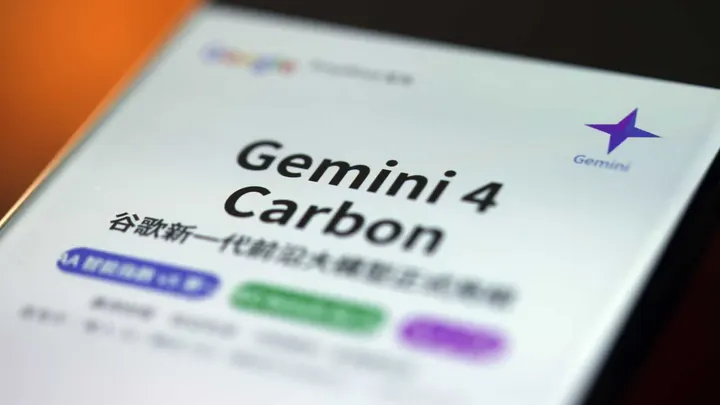
Last week, Google released its latest AI model, Gemini 4 Carbon, topping intelligence rankings charts. The model has landed with a grander splash than most. As Artificial Analysis highlights , Gemini 4 Carbon is now the highest-ranked AI model on its latest Intelligence Index V5 benchmark suite, beating Claude Opus 5.5 by one point. It achieves the number one score across four of the nine evaluations, and does so at…
Last week, Google released its latest AI model, Gemini 4 Carbon, topping intelligence rankings charts. The model has landed with a grander splash than most. As Artificial Analysis highlights , Gemini 4 Carbon is now the highest-ranked AI model on its latest Intelligence Index V5 benchmark suite, beating Claude Opus 5.5 by one point. It achieves the number one score across four of the nine evaluations, and does so at a lower cost per task than other high-ranking models, like Claude Opus 5.5. Google is offering access to the model for cyber defenders first through its Fairwind program, with wider availability coming sometime after. Perhaps more crucially, Gemini 4 Carbon stands apart by topping Artificial Analysis' new AA-Omniscience v 1.1 test that tracks hallucinations and knowledgeable recall of information. As governments and institutions look to maximize value and security from their use of AI, being able to claim the lowest hallucination score could prove a significant selling point. Then again, even the best scored only 54 on the -100 to +100 scale, suggesting even the best frontier models in 2026 are a far cry from being consistently reliable when it comes to accurately recalling information. The king is dead, long live the king AI model rankings change fast and regularly in 2026, and it's no surprise that the latest release from a frontier lab has pushed the envelope, but Google's Gemini 4 Carbon can be seen as a comeback after languishing with irregular releases for much of the year. Gemini 4 Carbon (high) scores a 59 on the Artificial Analysis Intelligence Index V5 benchmark. That puts it a single point ahead of Claude Opus 5.5 (max with fallback), and two points ahead of OpenAI's GPT-6 Astra (max). It's also nine points ahead of Meta's Muse Wonder Full (Max), and 10 points ahead of Claude Fable 5.1 (max with fallback). But raw, generalized intelligence isn't the whole picture with frontier models in 2026. As developers chase the Pareto frontier — the best-possible confluence of cost and intelligence — Gemini 4 Carbon is also impressively affordable. Its cost per task on the Intelligence Index test is actually slightly cheaper than Gemini 3.8 Flash (high), priced at $7.76 each. That's several dollars cheaper than either Claude Opus 5.5 or Sonnet 5.5, both max with fallback, and not far off half the price of Claude Fable 5.1, which costs $12.99 per task. Gemini 4 Carbon is still more expensive than OpenAI's GPT 5 Astra and about six times more expensive than GPT 6.1 Sol (max). It's about 13 times as expensive per task as the open-weight DeepSeek V4.1 Flash 1017, too, although that model measures a mere 32 on the Intelligence Index rankings. Gemini 4 Carbon isn't the best at everything, but it may be the best at most of the high price points. At least for now. Arena.ai has it holding the top spot on its Pareto Frontier chart at the more expensive end of the spectrum, but at lower price points, the Chinese open-weight models like GLM 5.3-Flash and DeepSeek V4 Pro take over. Artificial Analysis also highlights that Gemini 4 Carbon isn't as good as Claude Code with Claude Opus 5.5 at programming, and it falls behind Grok 4.7, Muse Wonder, and Kimi K3.1 Pro on knowledge work. But perhaps the most impressive score is Gemini 4's 54 on the AA-Omniscience Index, which tracks knowledge and hallucinations, beating out the competition by often significant margins. Gemini 4 Carbon costs $7.76 per Intelligence Index task, ~23% less than Claude Opus 5.5 (max, $10.04) but ~1.2x GPT-6 Astra (max, $6.25). It uses 123k output tokens per task, 29% fewer than Claude Opus 5.5 (max, 173k). At the same $4/$20 standard pricing, its Cost per Task is in line with Gemini 4 Argon ($7.68), while scoring 9 points higher on the Intelligence Index. October 28, 2026 Careful and Compliant In Google's announcement of the new Gemini 4 model , it talked up its collaboration with the U.S. government for model screening and pre-release testing. In a similar manner to the way Anthropic handled Mythos' release in 2025, Google is rolling out access to Gemini 4 Carbon at a slower pace. "We're taking a deliberate approach to rollout and are actively engaged in the U.S. government’s voluntary process for pre-release model testing," Google's launch statement reads . To that end, it's opening up Carbon to a subset of "cyber defenders," and will gradually make the model more widely available through trusted partners through its Fairwind Program . Before it makes Carbon available to developers, it wants to iterate on its guardrails to make the AI safer and more effective for cybersecurity purposes, making it harder for nefarious actors to use it for exploits and hacking. Where the idea of slowing the industry and introducing greater oversight for model development has risen and fallen in the estimations of the major tech companies, it does appear to be cementing itself as more of a foundational idea for future model releases. Google talks up its release on the improved safety and security of its model, highlighting that it thwarted all attempts from the Gray Swan Indirect Prompt Injection benchmark to have it do something it shouldn't. Google claims Carbon cuts unsupported claims in its responses twice as much as the Gemini 4 Argon model it debuted just two weeks ago. If it can't complete an action, it will just not do so, rather than fabricating an answer or hedging around missing evidence, Google claims. It also suggests Carbon will present sources and suggested actions to the user more readily, rather than pursuing its own intentions when there are discrepancies or uncertainties, allegedly cutting model overreach by 26%. As governments and companies look to make realistic use of AI, tracking usage, managing token budgets, and preventing workers from creating new exploit paths through overuse, a model's safety, security, and reliability will be paramount. Gemini 4 Carbon scores 54 on AA-Omniscience, the highest of any model, 6 points ahead of Claude Opus 5.5 (max, 48). It answers more questions correctly than Gemini 4 Argon (58% vs 48% accuracy), at the cost of a higher hallucination rate (11% vs 4%). This is still far below Claude Opus 5.5 (max) and GPT-6 Astra (max), both at 50% October 28, 2026 A new Pareto Frontier? For the past year, a clear focus from frontier and open-weight model developers has been on efficiency and cost. While raising intelligence and improving capabilities, particularly through agentic workflows, has seen great development alongside pomp and circumstance, many of the major announcements and developments have also considered cost a clear component. That's not likely to change, with the latest research from Gartner showing that just 3% of companies are actually achieving cost and productivity improvements from AI use. But as organizations push to find the real value in AI, maximize token budgets, and try to empower workers who have found improvements from using AI, they'll want consistency. Tracking return on investment with AI is notoriously difficult, with hallucinations making that far harder. If Google can sell its latest model(s) as the safest and least likely to hallucinate, and do so with high intelligence at a relatively low cost, that might be the new winning formula. At least until the next model drops.