Apple iMac M6 review: Faster, more expensive and deeply in need of a refresh
Most buyers would be better off with a Mac mini and a bigger external display.
Apple iMac M6 review: Faster, more expensive and deeply in need of a refresh
Most buyers would be better off with a Mac mini and a bigger external display.
We may receive a commission on purchases made from links.
With its new iPhone Duo and MacBook Pro touchscreen models, Apple is finally embracing change and shaking up its product mix. Unfortunately the new iMac M6 all-in-one — once one of Apple's most revolutionary products — has not been a beneficiary of that new ethos.
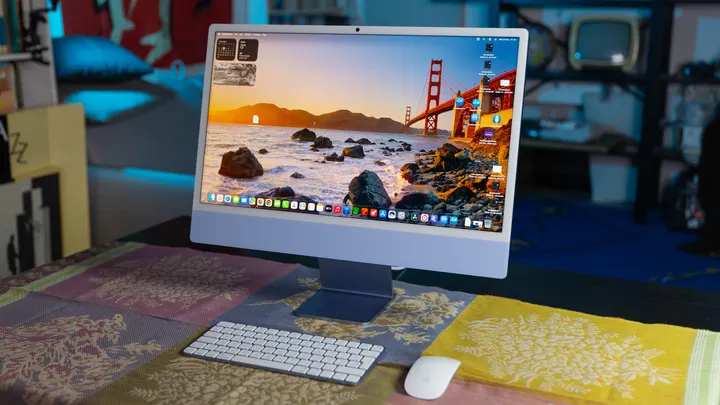
It is faster than ever thanks to the new M6 chip and updated memory. But the design, which hasn't changed since the 2021 iMac M1, is getting stale. The 24-inch display's small size is more of an issue than ever, considering that 27- and 32-inch monitors are now the norm. It's still a solid computer for consumers or business users, but at a $1,499 starting price ($200 more than before), there are better options — including other Macs.
What's new for 2026
I tested the iMac M6 in a pretty, pale blue color, with the higher-end 12-core CPU, 12-core GPU (with a dual 16-core neural engine) and 16GB of memory. After recently reviewing a Mac Studio M5 Ultra with 256GB of RAM, I was curious to try a Mac model configured with the least amount of memory possible.
Apple didn't release a new iMac last year, so the biggest change from the 2024 model is an upgrade from the M4 to the M6 processor. The new chip adds two extra cores to both the base and high-end models, with the latter offering up to a 12-core CPU and 12-core GPU instead of 10 cores for both as before. Apple says that memory bandwidth is higher as well at 170GB/s max, compared to the previous 120GB/s. The new model also comes with Apple's latest N1 wireless chip, so it now supports Wi-Fi 7 and Bluetooth 6, compared to Wi-Fi 6E and Bluetooth 5.3 on the iMac M4.
Otherwise, the new iMac is the same old iMac. It still comes with a 24-inch 4.5K (4,480 x 2,250) 500-nit IPS display, available with and without a nano-textured coating that reduces glare (a $200 option). The elegant stand still has a tilt but not a height adjustment, and it offers four Thunderbolt 4 ports on the higher-end model and two on the base version. Other features carried over from before include the magnetic power connector, 3.5mm headphone jack and sharp 12-megapixel webcam introduced on the last model.
The iMac is available with the same seven color options as before, including blue, green, pink, yellow, purple, orange and silver, with accessories (the mouse, keyboard and cables) in matching shades. The colors on the front are subdued, but they're more saturated on the back.
In-use: Big speeds, small screen
Since the iMac skipped the M5 chip, the M6 model is noticeably quicker than before. Apple claims it's up to 50 percent faster for productivity apps like Microsoft Excel compared to the last model, while offering a similar speed bump for things like photo and video editing.
The M6 chip is particularly proficient for AI, with Apple claiming five times faster on-device performance in LM Studio compared to the M4 model. However, keep in mind that AI models work best with plenty of memory and the iMac only offers 16GB, 24GB or 32GB configurations — tied with the MacBook Air for the least of any Mac product.
In my tests, performance largely lived up to Apple's claims. The iMac M6 scored 4,552 and 20,363 points on Geekbench 6's single- and multi-core CPU tests, around a 20 percent bump from the previous model. It did even better on Geekbench 6 GPU (metal) with a mark of 88,276, more than double the previous model. Cinebench 2024 scores were also up 38 percent on the GPU side and 25 percent/40 percent in single/multi-core tests compared to the iMac M4. Finally, the M6 iMac scored 81,050 on Geekbench AI ML, a significant increase from 50,704 before.
Disk speeds are key for low-memory computers, and fortunately, the iMac M6 didn't disappoint here. Those were more than double the previous model, with 12.4GB/s write and 6.76GB/s read speeds — right up there with the Mac Studio M5 Ultra's pace.
Benchmarks are one thing, but I was keen to test the new iMac for quotidian tasks like content creation, gaming and AI. As a machine for school or corporate work, it's great, with minimal lag and zippy performance for spreadsheets and video calls. It's also nice for entertainment, thanks to the bright and colorful (but too small) display with 4K HDR. The six-speaker setup with two force-canceling woofers and Dolby Atmos support also provides decent sound for an all-in-one (AIO) PC.
For some chores, though, my machine was impeded by its relatively meager RAM allocation. Blackmagic Design's DaVinci Resolve is a great test for creative work, and though the iMac did better than I expected, I saw a few issues. I was able to play back a mix of 4K MP4 files from a DJI drone and 6K RAW Nikon files without any issues. However, after adding effects, extra tracks and completing more edits, I saw some interface lag and playback skipping. For basic TikTok and YouTube editing, though, the iMac M6 performed well for me.
Gaming's not a strong point, though. With Cyberpunk 2077, I saw just 50 fps at 1080p with the default graphics settings, and was only able to achieve 60 fps dialing down the quality. Other games like Resident Evil Biohazard and Baldur's Gate 3 had similar performance issues, with 1080p resolution the maximum possible for playable frame rates. With an extra 8GB of RAM, my colleague Devindra Hardawar saw slightly better performance when gaming on a Mac mini with the same M6 chip.
When it comes to AI work, my machine definitely needed more RAM. I tested it using LM Studio with the quen3.5-9b model that matches well to this Mac. It ran at around 30 tokens per second for translation and other prompts, which isn't amazing for a machine at this price. Due to its small model limitations, it also produced some inaccuracies, so the iMac M6 won't be the AI computer of your dreams unless you upgrade the memory.
In my last iMac review, I said that the 24-inch display was "ample" for most work, but I'm no longer of that mind. With extra speed that makes the iMac more useful for AI and creative work, the display is simply too small and that Apple needs to offer at least a 27-inch screen on future models.
Should you buy the iMac M6?
Though its design is getting dated, there's still a lot to like about the new iMac M6. It's a good productivity and entertainment machine, and it can even handle light gaming and creative work. The main problem, for me, though, is that you no longer get enough for your money. The base model starts at $1,499 with 10-core CPU and 10-core GPU, but the sweet spot is the version with the 12-core CPU and GPU and 24GB of RAM — more speed and two extra Thunderbolt ports. All of that pushes the price up to $1,899.
Here's the problem: You can purchase a Mac mini with the same M6 chip and 24GB of RAM for $1,099, leaving you $800 to buy a bigger and brighter display with a height adjustment, like LG's 27-inch 5K Ultragear Mini-LED model. Or, you could get a cheaper monitor and spend less.
With that said, if you really want an AIO computer for its simplicity and ease of setup, the iMac is the best one out there. It outperforms Windows models like the Lenovo Yoga AIO 27 for a similar price, particularly in the areas of productivity and content creation. If you don't mind a couple of extra cables, though, the Mac mini with a bigger display is a better option for most people.