AI Security Agents Compared: Claude, Codex, Mantis, Cloudflare
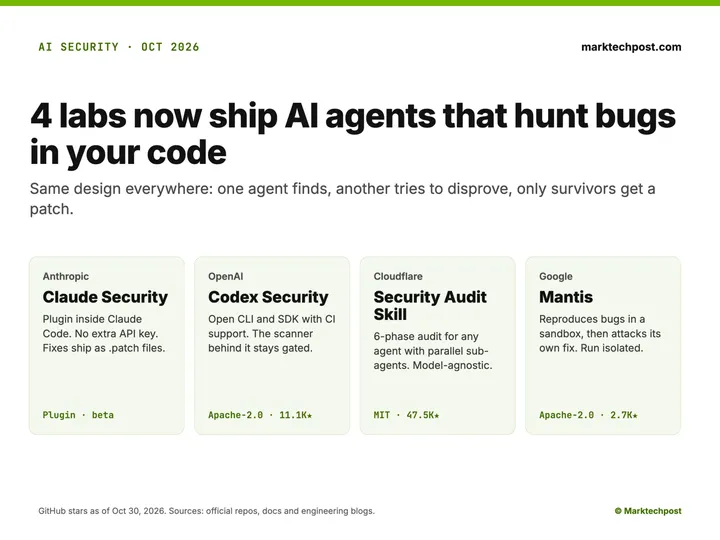
Anthropic, OpenAI, Cloudflare and Google now each ship an AI agent that hunts security bugs in source code. We checked the repos, docs and technical details behind each one. The key finding: all 4 tools converge on one design. One agent finds a bug, a separate agent tries to disprove it, and only survivors get a patch. The differences are in where they run, who can use them and how much proof they demand. Key…
Anthropic, OpenAI, Cloudflare and Google now each ship an AI agent that hunts security bugs in source code. We checked the repos, docs and technical details behind each one. The key finding: all 4 tools converge on one design. One agent finds a bug, a separate agent tries to disprove it, and only survivors get a patch. The differences are in where they run, who can use them and how much proof they demand. Key Takeaways 4 labs, 1 pattern: find, independently disprove, then patch. Claude Security runs inside Claude Code; no extra API key needed. Codex Security’s CLI is Apache-2.0, but scanning still needs OpenAI access. Cloudflare’s skill is MIT, model-agnostic and the most-starred at 47.5K. Google’s Mantis reproduces bugs in a sandbox; Google says isolate it. Why 4 labs shipped the same thing in 2026 The problem every one of them is solving is noise. Google’s security team writes that sloppy AI code scanning produces hallucinated bugs and true-positive rates under 7% . A scanner that is wrong 93% of the time costs reviewers more than it saves. The shared fix is separation of duties. The agent that reports a finding never gets to confirm it. Cloudflare states the rule directly in its README: the verifier is never the agent that found the bug. Anthropic, OpenAI and Google each describe a similar validation step before anything reaches a report. The second driver is offense. Anthropic team states that it built its scanner partly because attackers were already using AI models to find exploitable flaws, per The Hacker News . Google opens its Mantis post by noting that models can now discover and exploit bugs with little human help. 1. Claude Security by Anthropic What it is: A multi-agent vulnerability scanner that runs inside a Claude Code session. It is the local version of Anthropic’s hosted Claude Security product, per the plugin README . How it works: Agents map the architecture, build a threat model, hunt across every component and verify each finding independently. The plugin offers 3 jobs from one menu: scan the codebase, scan changes, or suggest patches, per Claude Code docs . Output: A Markdown report along with a SARIF 2.1.0 file for GitHub code scanning. Each finding carries severity, a CWE category, impact and reproduction steps. Patches are drafted in a scratch copy and land as F<n>.patch files. The plugin never commits, pushes or opens a pull request on its own. Cost and access: It makes no model calls of its own, so there is no separate API key. Scans count against your Claude plan’s usage limits. Copy Code Copied Use a different Browser /plugin install claude-security@claude-plugins-official /claude-security Timeline: Anthropic opened a limited preview called Claude Code Security in February 2026. The hosted product reached public beta for Enterprise customers on Claude Opus 4.7 . The Claude Code plugin entered beta on July 22, 2026, per Cybersecurity News . In August, the hosted scanner moved to Claude Mythos 5, per Dataconomy . Where it fits: Anthropic positions it as one layer. The security-guidance plugin checks code as Claude writes it, and /security-review does a single pass on a branch. Claude Security is the on-demand deep scan. 2. Codex Security by OpenAI What it is: A CLI and TypeScript SDK, published as @openai/codex-security, for finding, validating and fixing vulnerabilities. How it works: It scans a whole repo, selected paths, or a Git diff. A –mode deep flag runs parallel discovery workers. It validates candidate findings, generates patches and can verify existing fixes. A cs policy command drafts a SECURITY.md that tells future scans what counts as a vulnerability in your project. Output: Threat models, SARIF, JSON or CSV exports, plus publishing to Linear. It can import GitHub code-scanning alerts and suggest owners from Git history. A GitHub Action runs scheduled or pull-request scans; findings are report-only by default. Copy Code Copied Use a different Browser npm install --global @openai/codex-security cs login cs scan Cost and access: The client is Apache-2.0, but the scanner behind it is not. DevOps.com notes the CLI and SDK stay in limited beta for approved customers. The README lists OpenAI, Amazon Bedrock, OpenRouter and Fireworks AI as providers. Requires Node.js 22.13+ and Python 3.10+. 3. Security Audit Skill by Cloudflare What it is: An MIT-licensed skill that turns any capable coding agent into a security auditor. How it works: A 6-phase audit: Reconnaissance: map architecture, trust boundaries and input surfaces into architecture.md and a coverage ledger. Coverage-led hunting: isolated hunters each take ledger units; coverage critics look for gaps. Candidate validation: a fresh verifier tries to disprove every unique candidate. Structured output: confirmed, needs_validation and rejected records go to findings.json, checked against a schema. Independent record verification: new agents re-verify every final source claim. Target-neutral reporting: REPORT.md and detail files are derived from the verified records. Requirements: A coding agent that supports tool use and parallel sub-agents, plus Node.js for the validators. It also wants an OS-enforced sandbox with no external network. Without one, leads stay needs_validation instead of being executed. npx skills add https://github.com/cloudflare/security-audit-skill –skill security-audit Then ask the agent: “security audit this codebase.” Output defaults to ~/security-audit-skill/<repo-name>/run-<N>, outside your repo. The data behind it: Cloudflare published the skill on June 18, 2026, with its post Build your own vulnerability harness . The roughly 450-line skill seeded an internal harness that now scans 128 repos. Cloudflare reports these lifetime numbers: 20,799 raw candidates from discovery, about 12,057 of which survived validation. 13,841 findings in the shared triage pool across 145 repos, including another harness’s output. 5,442 folded away as duplicates and 1,154 routed out as wrong-repo or low-risk. 7,245 actionable findings sent to engineering teams. Better recon context cut the first-pass rejection rate from 40% to 11%. Cloudflare also uses one model for discovery and a different model for triage, so models check each other. 4. Mantis by Google What it is: An Apache-2.0 set of security-review skills plus an ADK reference harness for AI coding agents. Google team states that it is part of how it finds and fixes bugs internally. How it works: Mantis reads the repo’s history to learn from past security fixes. It builds a hierarchical summary tree, condensing files into directory and root summaries. Google team states that this cut token overhead by over 85% . It then generates a threat model and hypotheses, hunts, deduplicates and critiques findings. What sets it apart: Reproduction and patch verification. Mantis tries to reproduce each bug, from a static exploit sketch up to a unit test or mock server. It patches with an adversarial loop that attacks the fix. It also calibrates severity against a rubric to stop “thousands of criticals.” A mantis-advise skill then feeds what it learned back into code generation. Setup: Clone the repo and point any coding agent at it, or run the ADK harness directly. The harness supports a –focus prompt such as “look for IDOR” and a –max-tokens spend ceiling. Copy Code Copied Use a different Browser git clone https://github.com/google/mantis.git cd mantis/reference && ./install.sh ./run.sh path/to/code Side-by-side Tool License Runs where Model lock-in Proof step Patches Security Audit Skill (Cloudflare) MIT Any coding agent with parallel sub-agents None Fresh agent disproves; second independent verification No Codex Security (OpenAI) Apache-2.0 client; hosted scanner CLI, SDK, GitHub Action OpenAI-gated; Bedrock, OpenRouter, Fireworks supported Validates candidates; verifies fixes Yes Mantis (Google) Apache-2.0 Any coding agent or ADK harness, isolated env None Sandboxed reproduction; adversarial patch loop Yes Claude Security (Anthropic) Plugin in Anthropic’s official marketplace Claude Code session Claude models Independent verifier panel Yes, as .patch files Beyond the big 4: other AI bug hunters launched in 2026 At least 12 more agent-based vulnerability tools shipped or went public in 2026. Almost all repeat the same find-then-independently-verify loop. They split into free harnesses you run yourself and commercial or internal platforms. Open-source harnesses Tool From Released What stands out Visa Vulnerability Agentic Harness (VVAH) Visa Jun 10, 2026 Built after testing Claude Mythos Preview via Project Glasswing. A 4-phase, 11-stage pipeline with policy gates and human review; works with Claude or OpenAI-compatible models. Remediation and fix validation added later . OpenHack Hadrian May 25, 2026 MIT. Runs inside Claude Code, Codex or Cursor with all state kept in plain files. Expert agents prove or reject scenarios; an independent triage agent picks final findings. deepsec Vercel Labs May 4, 2026 MIT. A regex prefilter picks security-sensitive files, agents investigate, a second pass revalidates. Vercel fans scans out to 1,000+ concurrent sandboxes . AppSec Santa also tracks harnesses from Anthropic (defending-code-reference-harness), Trail of Bits, Capital One (vulnhunter) and Cisco (ai-deep-sast). Cisco’s runs fully local on Foundation-Sec-8B, so no code leaves the machine. Commercial platforms and internal systems Tool From Launched Status What stands out Signal Agentic Fix Black Duck Oct 28, 2026 Launched Scan, triage, fix, validate, submit. Works alongside coding agents such as Claude Code; every change goes to a human. Continuum for code vulnerabilities AWS GA Oct 22, 2026 (preview Jun 17) GA in 2 US regions Checks exploitability against your actual AWS setup and opens fix pull requests. Absorbed the former AWS Security Agent. Every fix needs human approval. Evo Agentic AppSec Snyk Oct 15, 2026 Preview Agents drive Snyk’s deterministic engines as tools. Snyk’s own VulnBench found 49.7% of LLM-only review findings vanish on the next run. PageBreak Google Product Security Disclosed Sep 24, 2026 Internal only 500+ verified XSS bugs in Google’s own web apps. Separate, non-AI validators fire each exploit at a running app before anyone sees it. Agentic Workflows Semgrep Jul 28, 2026 Public beta 9 prebuilt workflows covering 70+ CWEs. Pairs deterministic taint analysis with frontier models such as Claude Opus. Patch the Planet OpenAI + Trail of Bits Jun 22, 2026 Program Engineers using Codex Security and GPT-5.5-Cyber across 19 open-source projects. First week: 64 PRs and 51 issues . MDASH Microsoft May 12, 2026 Expanded preview 100+ agents on an ensemble of models. Found 16 new Windows bugs, 4 of them critical RCEs. Red Agent Wiz RSA 2026; preview Apr 22 GA Attacks live APIs and apps from outside rather than reading source. Runs on Claude Opus among other models. Xint Code Theori Disclosed Apr 29, 2026 Commercial Found “Copy Fail” (CVE-2026-31431), a 9-year-old Linux root bug, in about 1 hour of scanning. CISA added it to its exploited-vulnerabilities list. The pattern holds across vendors: deterministic engines or validators do the proving, models do the reasoning, and a human approves every fix. Which one to run first Already on Claude Code: start with the Claude Security plugin. It installs in 1 line and uses your existing plan. Need CI gating and SARIF in GitHub: Codex Security has the most mature pipeline tooling, if your org has access. Want no vendor lock-in: Cloudflare’s skill runs on any agent with parallel sub-agents and is fully MIT. Have a security team and a sandbox: Mantis gives the deepest proof loop, with reproduction and adversarial patch testing. Cloudflare’s own architecture suggests a practical combination. Run discovery with one tool or model, then validate with a different one. Different models surface different shares of the bugs.